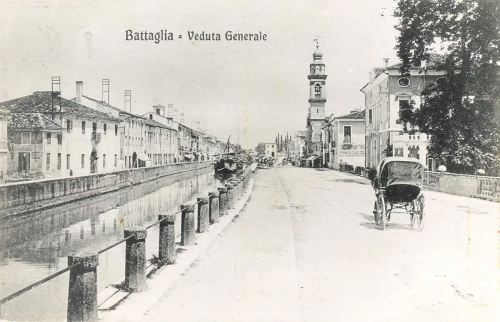
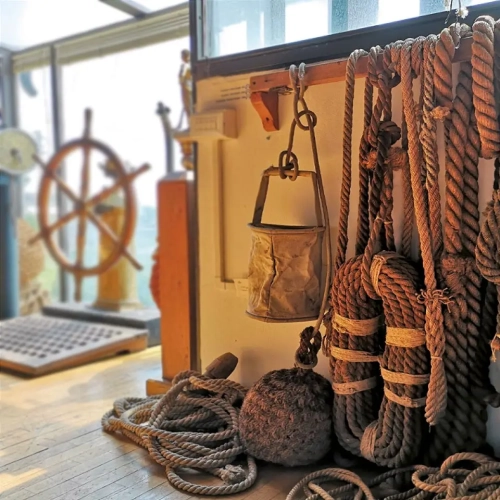
The Museum of River Navigation is located east of the banks of the Battaglia Canal, in what is known as the old village of Battaglia Terme.
The earliest historical records of the village's origins date back to the 13th century, coinciding with the excavation of the canal desired by nearby Padua, in order to have a direct and fast access route to the Euganean Hills and Monselice, thus fostering economic development and trade with Venice and the entire Po Valley, as well as the transformation of the area's economic vocation from agricultural to industrial and commercial.
The past of this town, its connection with water, can still be felt along the streets of the old village, characterized by rows of colorful little houses facing the banks of the Canale di Sotto, along whose banks it is still possible to admire one of the piers from which boats once departed.
The Ortazzo Quarter is as classic as it is picturesque an example of a fishing settlement; going up the street, it is possible to see the waterfall that passes under the arches of the disused power plant, and next to it the imposing building that had once been an important mill and where the Battaglia harbor was located.
Continuing in the direction of the State Road, one reaches the banks of the Battaglia canal, which is overlooked by the Church of San Giacomo, dating from 1748, and is crossed by a typical Venetian-style bridge, called Ponte degli Scalini, which leads toward the more modern gateway to the town.
Following the canal in a northerly direction, one encounters the cavana where various boats used in the sport of Venetian rowing are moored today. Next to it, although a little difficult to observe, is the navigation lock of Battaglia Terme, a hydraulic system that through sluice gates is used to regulate the level of water in the canals, proving to be still functional today.